
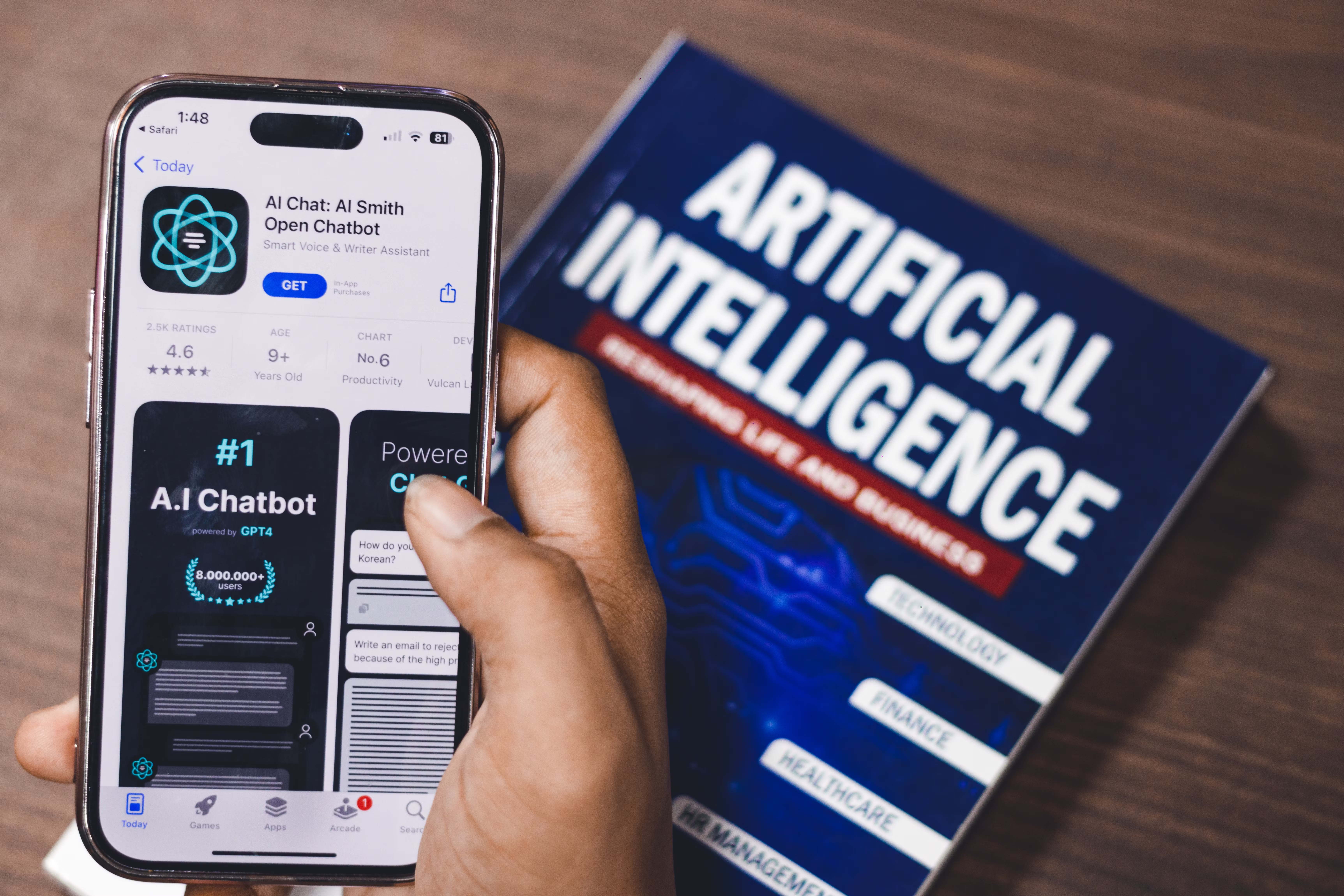
AI Search Optimisation: A Beginner Guide to GEO and AEO starts with a simple idea: people are no longer only searching through classic blue-link results. They are also asking AI-powered systems for summaries, recommendations, and answers. That shift matters because your content may be discovered, quoted, or overlooked in places such as Google AI Overviews, Google AI Mode, ChatGPT Search, Perplexity, Microsoft Copilot Search, Gemini, or Claude.
For website owners, this is less about chasing a new trick and more about understanding how generative search and answer engines interpret content. The goal is to make your site clear, credible, technically accessible, and useful enough that both people and AI systems can understand it well.
What GEO and AEO mean in plain English
GEO stands for Generative Engine Optimisation. AEO stands for Answer Engine Optimisation. These terms are used to describe content and technical practices that may help a site be understood and surfaced by AI-driven search experiences. They are not fixed, universal standards, and different marketers may use them differently.
Traditional SEO still matters. GEO and AEO do not replace it; they sit alongside it. Strong page titles, useful headings, crawlable pages, internal links, and accurate content can all support discoverability in both standard search results and AI-assisted experiences. But no method can guarantee selection in an AI-generated answer.
For readers who want a broader SEO foundation as they learn these concepts, the free website SEO audit from Backlink Works can be a useful starting point for spotting technical or content issues that may also affect AI visibility.
How AI search differs from classic search results
AI search experiences often present information in a conversational format. Instead of showing a long list of links first, the system may summarise a topic, answer a question directly, and then show a small number of sources. Some platforms may include clickable citations, while others may mention a brand without linking, or may not cite every source used in the summary.
This means visibility can take several forms. A site may appear as a cited source, be mentioned by name, receive a referral visit, or simply influence the model’s answer without obvious attribution. Those are not the same outcome, and they should not be measured as if they were.
Different systems also behave differently. Google AI Overviews and Google AI Mode, ChatGPT Search, Perplexity, Copilot Search, Gemini, and Claude do not present information in identical ways. Their interfaces, source presentation, web access, and retrieval behaviour may change over time, so it is wise to treat platform guidance as current rather than permanent.
Why conversational search changes content planning
Users increasingly ask longer, more specific questions such as “What is the best way to compare running shoes for flat feet?” rather than typing only a few keywords. That makes conversational search, semantic search, and topic coverage more important. Pages that answer a clear question well are often easier for both humans and machines to process.
What helps AI visibility without relying on shortcuts
There is no confirmed formula for AI citations or recommendations, but several practical factors can improve the chance that your content is understandable and useful. Start with clear entity optimisation: make it obvious who you are, what your business does, where you operate, and what topics you genuinely cover. Keep business names, author details, and contact information consistent across your site and important profiles.
Structured data can also help machines interpret page meaning. Use schema markup only where it matches the visible content, and avoid misleading data. For example, product pages, articles, organisation details, and local business information should all be accurate and honest. Google’s guidance on AI features in Google Search is a sensible place to understand how search may present enhanced responses, though it does not provide a guarantee of inclusion.
Equally important is content quality. AI systems tend to work better with pages that are well structured, factually accurate, and genuinely helpful. That includes concise definitions, clear subheadings, and supporting detail that answers likely follow-up questions. Thin, repetitive, or unclear pages are less likely to support strong visibility in any search environment.
AI citations, brand mentions, and referral traffic
It helps to separate a few related outcomes. A clickable citation sends a user to your page. A text-only brand mention may increase awareness without a direct click. A product or service recommendation is stronger still, because it suggests the system is presenting your brand as a useful option. Referral traffic is the visit that actually reaches your site. And a traditional search impression is not the same as any of these.
An AI-generated answer may cite multiple sources or combine information from several pages into one response. In some cases, it may mention your brand without linking. In others, it may cite a source while still sending little traffic. Because of that, visibility work should focus on more than just the presence of a name in an answer.
Monitor whether AI-assisted visitors are landing on the right pages, whether branded queries are increasing, and whether the information presented about your business is accurate. You can also use Backlink Works’ backlink building process guide to think more clearly about authority signals, but avoid equating backlinks alone with AI search success.
Technical access, crawlability, and content hygiene
AI search visibility can depend on technical accessibility as much as editorial quality. Search-engine crawlers, AI-related crawlers, training-related crawlers, and user-triggered retrieval systems may operate differently. Blocking or allowing one crawler does not necessarily determine what appears in every AI product, so any robots.txt or server-rule changes should be made carefully and tested first.
Good technical hygiene still matters. Pages should be indexable, fast enough to load reasonably, and free from accidental blocking. Internal links help users and crawlers move through related content. Clear canonicalisation, sensible URL structure, and accurate metadata also make it easier for systems to understand what each page is about.
If your site uses AI-assisted content creation, human review becomes essential. AI-written drafts can be useful, but they can also introduce factual errors, weak sourcing, outdated statements, or a tone that does not match your brand. Publish content for readers first, then refine it so that it is accurate, original, and genuinely useful.
How to measure progress without overclaiming
AI search analytics is still developing, and reporting is often incomplete. Some traffic may appear as referral traffic, some may be classed as direct, and some user journeys may be difficult to attribute cleanly. That means you should look at a mix of signals rather than expecting one perfect dashboard.
Useful measures include referral visits, assisted conversions, branded search changes, landing page performance, recurring query themes, and accuracy of brand mentions. If you use Google Search Console or analytics tools, compare this with the pages that already perform well in traditional search. Strong pages often have better chances of being understood by AI systems, but that is not the same as a guarantee.
A practical next step is to review your content from the perspective of a user asking a question. Does the page answer quickly and accurately? Is the source clear? Are there obvious definitions, examples, and next steps? If not, improve the page before worrying about platform-specific tactics.
Conclusion
AI search optimisation is best treated as an extension of good SEO, not a replacement for it. GEO and AEO can help you think more carefully about how content is interpreted in generative search and answer engines, but the fundamentals remain the same: create helpful pages, make them technically accessible, clarify your entities, and build a trustworthy brand presence.
Website visibility in AI-generated answers will continue to change as platforms update their interfaces, data sources, and presentation methods. The safest approach is to improve the quality and clarity of your site in ways that benefit both human readers and machine systems, while accepting that inclusion, citation, and traffic can vary by query and platform.
Frequently Asked Questions
Is GEO the same as SEO?
No. GEO is usually used to describe optimisation for generative AI search experiences, while SEO covers broader search visibility. They overlap heavily, and both benefit from clear, useful, technically sound content.
Can I optimise a page to appear in Google AI Overviews or ChatGPT Search?
You can make content easier to understand and access, but you cannot guarantee appearance in any AI-generated answer. Different platforms use different retrieval and presentation methods, and those methods can change.
Do structured data and FAQs guarantee AI citations?
No. Structured data can help explain page meaning, but it does not guarantee citations, rankings, or inclusion. It should always match the visible content on the page.
What should I track first if I want to understand AI search visibility?
Start with referral traffic, branded search interest, landing page engagement, and whether your brand is being described accurately. Those signals are more useful than chasing a single mention or citation.
- Sponsored Ad -





