
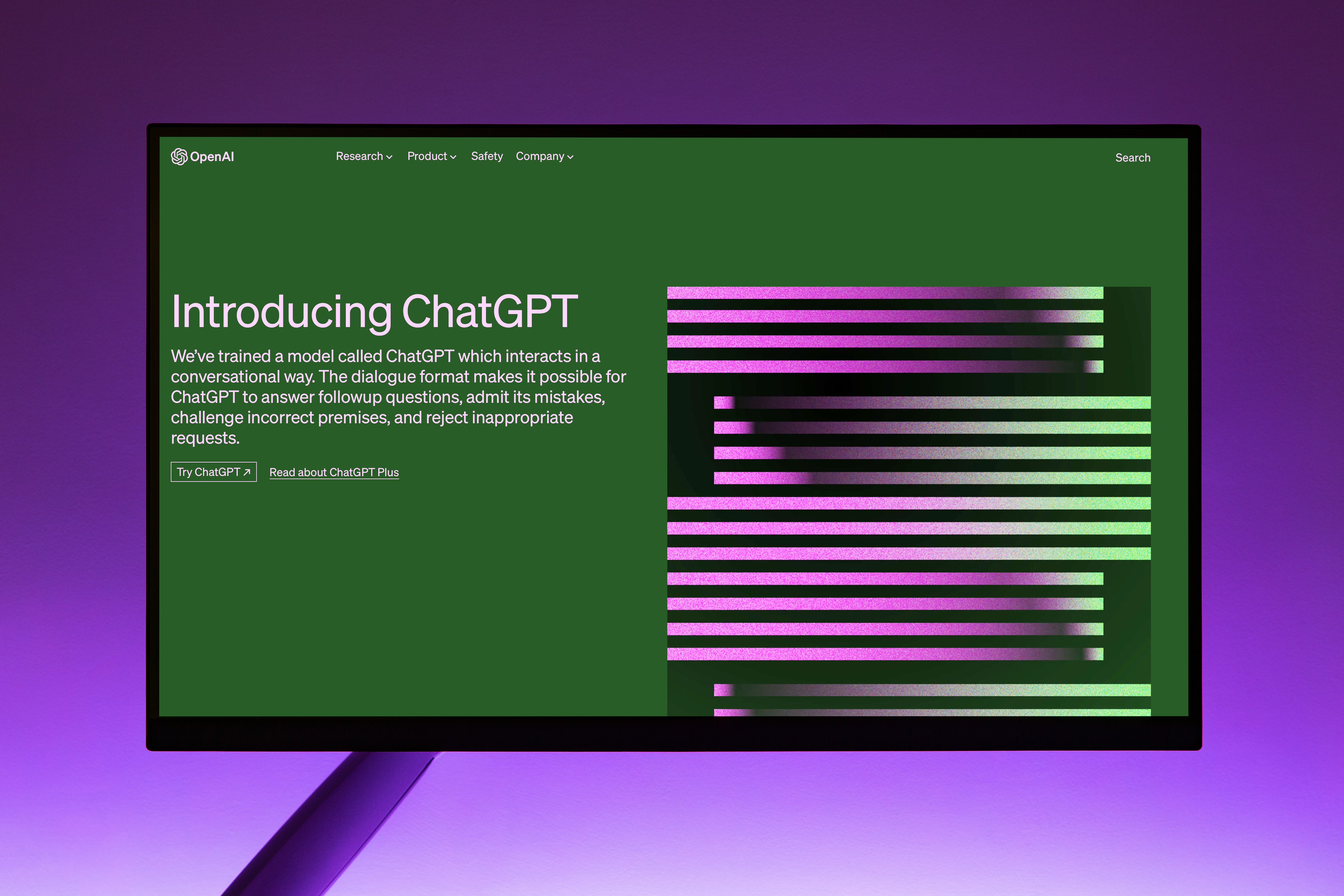
AI Search Visibility Guide: How to Optimise for Answer Engines helps website owners understand a new search behaviour: people increasingly ask questions in interfaces that generate direct answers, summaries, and source links rather than only showing a list of blue links. That includes systems such as Google AI Overviews, Google AI Mode, ChatGPT Search, Perplexity, Microsoft Copilot Search, Gemini, and Claude, each of which may surface information differently.
The practical goal is not to chase a single shortcut. It is to make your content easier for people and AI systems to understand, trust, and retrieve where appropriate. That usually means stronger SEO fundamentals, clearer entity signals, helpful content, sound technical access, and careful measurement of how your brand appears across AI-generated answers.
What answer engines are and how they differ from classic search
Answer engines are search experiences that try to provide a direct response to a query, often by summarising information from one or more sources. Instead of relying only on a ranked results page, they may combine web pages, structured data, and model-generated language to produce a conversational answer.
This changes user behaviour. People may ask longer, more specific questions, then follow up with refinements rather than starting a new search. For website owners, that can affect how content is discovered, how attribution is shown, and how a visit begins. A citation in an AI answer is not the same as a traditional ranking, and a brand mention is not the same as a referral visit.
It is also important to remember that different AI platforms do not function identically. Their interfaces, source selection methods, retrieval layers, and citation formats may vary, and those features can change over time. For Google’s AI features, the official guidance on AI features in Search is a useful place to check current documentation.
What Generative Engine Optimisation and Answer Engine Optimisation mean
Generative Engine Optimisation, often shortened to GEO, and Answer Engine Optimisation, or AEO, are terms used to describe content and technical practices intended to improve visibility in AI-generated answers. You may also see LLM visibility, LLMO, or AI SEO. These terms are still developing, and different marketers use them in different ways.
They are best treated as extensions of established SEO, not replacements for it. A page that is crawlable, indexable, accurate, clearly structured, and useful to humans is more likely to be understood by search systems of all kinds. But no page format, schema type, or wording pattern can guarantee inclusion or citation in an AI answer.
For most sites, the smartest approach is to improve content quality and clarity first, then support that with technical SEO, consistent brand signals, and better measurement. If you need a broader foundation, Backlink Works also publishes SEO education that can help connect backlink strategy with overall website visibility.
Content that AI systems can interpret more easily
AI search systems often work better with content that answers a question plainly, uses clear headings, and avoids vague claims. That does not mean writing for machines alone. It means helping human readers and retrieval systems understand the page quickly.
Useful content usually has a defined topic, accurate subheadings, plain-language explanations, and enough detail to satisfy the query without unnecessary filler. If your page covers a product, service, or process, explain who it is for, what it does, what it does not do, and where it fits into the broader topic. This is especially helpful for informational searches, comparison queries, and local or product-led questions.
AI-generated content can support this work, but it should be edited carefully. Unreviewed output can contain errors, duplicated phrasing, weak sourcing, or a tone that does not match the brand. Human review, fact-checking, and original expertise remain essential.
Entity optimisation, brand mentions, and source authority
Entity optimisation means making your business, authors, products, and topics easier for systems to identify as distinct things. In practice, that involves consistent organisation details, clear author pages, accurate contact information, and coherent references across your site and reputable third-party mentions.
This does not create a hidden ranking switch. It simply reduces ambiguity. If your brand name, service names, and page topics are consistent, it can be easier for search systems to connect them. Structured data can help describe those entities, but it should reflect visible content and not be used to exaggerate reviews, credentials, or business details.
AI citations should also be understood carefully. A clickable citation, a text-only brand mention, a recommendation, a referral visit, an organic impression, and a traditional ranking are different outcomes. One does not automatically imply the others. Tracking the context of mentions is often more valuable than counting them in isolation.
Technical access, structured data, and crawlability
Answer engines still depend on accessible web content. That means pages should be technically sound, fast enough to load, easy to crawl, and not blocked by avoidable configuration issues. Search-engine crawlers, AI-related crawlers, training-related crawlers, and user-triggered retrieval are not the same thing, so it is wise to check official documentation before changing robots rules or server settings.
Structured data can help clarify page meaning, such as an article, product, organisation, or local business. It may improve machine understanding, but it does not guarantee AI citations or inclusion in any generated answer. Use only markup that matches what users can actually see on the page, and validate it with an approved testing tool where appropriate.
If you want a practical starting point, review this free website SEO audit alongside your crawlability, internal linking, and page quality checks. Technical access is not the whole story, but weak technical foundations can limit discoverability before content quality even gets a fair hearing.
How to measure AI search visibility without overclaiming
AI search analytics is still developing, so measurement can be incomplete. Some visits may appear as referral traffic, some as direct traffic, and some may be difficult to classify cleanly. That means you should not rely on a single metric or expect every AI-assisted journey to be visible in analytics.
Instead, look for a few practical signals: branded search growth, referral visits from known sources, landing page performance, assisted conversions, recurring query themes, and accuracy of brand representation in AI answers. If your business is being mentioned incorrectly, that is a visibility issue even if traffic is steady.
It can also help to compare how your content performs in traditional search and in answer engines. Traditional rankings may still drive many visits, while AI-generated answers may reduce clicks for some queries and increase them for others. The effect depends on query type, interface design, and how the answer is presented.
For content teams, this means you should continue creating pages for human intent, not just for extractable snippets. A helpful article can be cited, summarised, or visited later; a thin article usually struggles on all three fronts.
Practical next steps and common mistakes
Start with a short audit of your most important pages. Check whether each page clearly answers a specific query, uses descriptive headings, includes accurate facts, and makes the brand or entity easy to identify. Then confirm that pages are indexable, internally linked, mobile-friendly, and supported by sensible structured data.
Avoid common mistakes such as publishing vague AI-generated copy without review, stuffing pages with repetitive phrasing, relying on misleading schema, or creating fake authority signals. Also avoid treating GEO or AEO as a shortcut around SEO. Traditional optimisation still matters because AI systems often rely on content that has already been made discoverable and trustworthy in the wider web.
If you manage a blog, ecommerce store, or service site, a useful checklist is simple: keep information current, cite real sources where needed, maintain consistent organisation details, and write in a way that a knowledgeable human would find clear and useful. That combination is far more sustainable than trying to guess a platform’s undocumented selection logic.
Conclusion
AI search visibility is becoming part of broader website discovery, but it should be approached as an extension of good SEO, not a separate magic discipline. The most reliable path is still to create accurate, helpful content, keep technical foundations strong, and make your brand easy to understand across your site and the wider web.
Because AI systems, citation formats, and interfaces can change, the best strategy is flexible rather than formulaic. Focus on clarity, authority, accessibility, and measurement, and treat every platform as distinct. That gives your content the best chance of being useful wherever answer engines choose to surface it.
Frequently Asked Questions
What is the difference between AI search visibility and traditional SEO?
Traditional SEO focuses on helping pages rank and perform in standard search results. AI search visibility adds the challenge of being understood, summarised, cited, or mentioned in generated answers. The two overlap heavily, so strong SEO still matters.
Can structured data get my site cited in AI answers?
No. Structured data can help explain page meaning, but it does not guarantee citations, recommendations, or inclusion in any AI-generated response. It works best when it accurately reflects visible content and supports clear page organisation.
How should I measure visibility in ChatGPT Search, Perplexity, Copilot, or Gemini?
Use a mix of referral traffic, branded searches, landing page performance, mention accuracy, and conversions where possible. Measurement is often incomplete, so it is better to look for patterns than to expect a single perfect report.
Should I change my content strategy only for answer engines?
No. Content should still serve human readers first. Answer engines may reward clarity and structure, but thin or over-optimised pages rarely help people, and they do not create a dependable visibility strategy.
- Sponsored Ad -





