
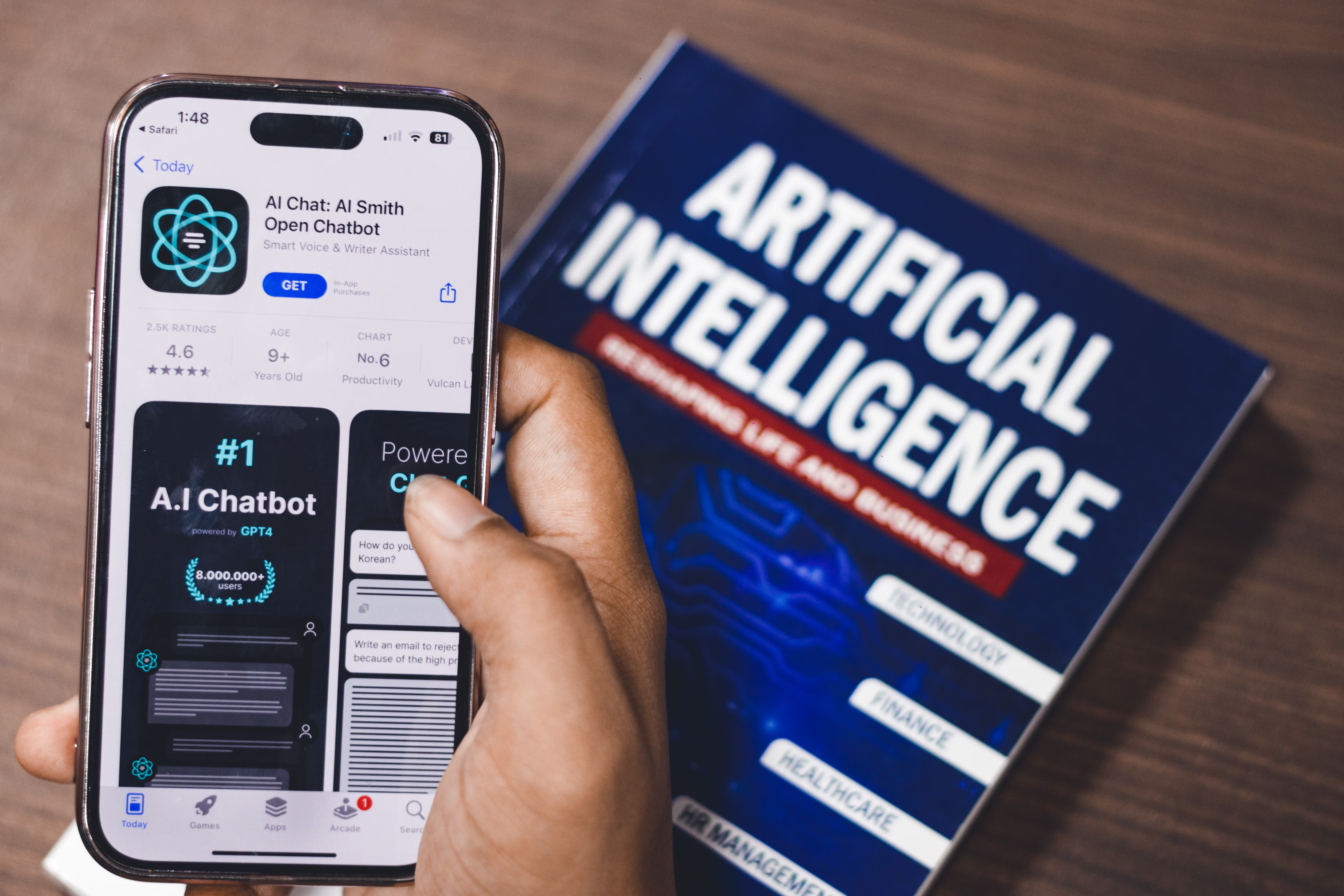
AI search is changing how people discover brands, products, and services. Instead of only scanning a page of blue links, users may now see a generated answer that blends information from several sources. Understanding how AI search mentions brands is useful for anyone who wants better visibility across Google AI Overviews, Google AI Mode, ChatGPT Search, Perplexity, Microsoft Copilot Search, Gemini, or Claude.
This does not mean traditional SEO has lost its value. It means website owners need to think about both search rankings and AI-generated answers. The practical goal is not to chase every mention, but to build content and technical foundations that make your brand easier to find, understand, and trust.
What AI search mentions actually are
In AI-assisted search, a brand can appear in several different ways. It may be cited with a clickable link, named in plain text without a link, recommended as an example, or mentioned as part of a broader summary. These are not the same thing. A brand mention does not always send traffic, and a citation does not always mean endorsement.
Different platforms also handle source selection differently. Some experiences may show explicit links, while others may summarise information with limited attribution. Because the interfaces and retrieval methods change over time, it is safer to treat AI visibility as a moving target rather than a fixed ranking system.
Why brand visibility in generative search matters
Generative search and answer engines can influence discovery early in the customer journey. A user may ask a conversational query such as “best accounting software for small charities” or “how to choose an e-commerce fulfilment partner”, then read an AI-generated answer before visiting a website. If your brand appears accurately in that moment, it can shape awareness, consideration, and trust.
That said, AI search traffic is not the same as traditional organic search traffic. A user may see your brand in an answer, then click through later, search for you directly, or never click at all. That is why visibility should be measured alongside engagement, assisted conversions, and brand accuracy rather than treated as a single win or loss.
How AI systems may decide what to mention
Exact selection processes are not publicly documented for every platform, so cautious wording matters. In general, visibility can depend on content quality, relevance to the query, crawlability, indexing, brand recognition, source authority, technical accessibility, online reputation, and the context of the question.
Strong traditional SEO foundations still help. Clear site structure, accurate page titles, useful internal linking, fast loading, and well-written content can improve discoverability for search engines and may support AI retrieval as well. You can also review the Google guidance on creating helpful content for a useful reminder that content should serve people first.
Generative Engine Optimisation, Answer Engine Optimisation, LLM visibility, GEO, AEO, LLMO, and AI SEO are still developing terms. They usually refer to practical work that improves how content is understood and surfaced by AI systems, but they are not a guaranteed replacement for SEO.
Building pages that are easier for AI to understand
AI search works best when your content is clearly about one thing, uses plain language, and provides evidence where needed. This often means defining entities clearly: your company name, product names, services, authors, locations, and topic relationships should be consistent across the site and wider web.
Structured data can help machines interpret page meaning. For example, Organisation, Product, Article, and Local Business markup may clarify what a page is about, but schema does not guarantee citations, rankings, or inclusion in AI answers. It should always match visible page content. For sites already using WordPress or other content systems, tools such as a free website SEO audit can help identify gaps in structure, indexability, and content clarity before making changes.
AI-generated content can be useful for drafting, clustering ideas, or speeding up research, but it should be reviewed carefully. Hallucinations, outdated facts, duplication, weak sourcing, and inconsistent tone can weaken trust. Human editing, fact-checking, and brand oversight remain essential.
Technical accessibility, crawler access, and structured content
There is an important difference between search-engine crawlers, AI-related crawlers, training-related crawlers, user-triggered retrieval, and traditional search indexing. A crawler that can access a page does not automatically mean the page will appear in an AI-generated answer. Likewise, blocking one crawler does not remove your information from every AI system.
If you are reviewing robots.txt, meta robots tags, or server rules, check current official documentation first and test changes carefully. Google’s robots.txt guidance is a sensible reference point for understanding crawl control, but the right approach will still depend on your site’s setup and your objectives.
Technical SEO still matters because AI search cannot reliably use content that it cannot access, interpret, or index. Clean URLs, internal links, stable navigation, canonicalisation, and clear page templates all help. For publishers and ecommerce stores, this is especially important where product detail pages, category pages, and editorial pages need to support both humans and machines.
How to measure AI search visibility without overclaiming
Measurement in this area is still incomplete. You may need to combine several signals: referral traffic, branded search demand, landing-page performance, assisted conversions, citation frequency, and recurring query themes. Some visits may appear as direct, referral, or unclassified traffic depending on the platform and analytics setup.
Do not assume that every mention leads to a click, or that every citation reflects a positive recommendation. Instead, track whether AI-generated answers are using your brand accurately, whether the surrounding context is fair, and whether any traffic they do send is relevant. Search Console, analytics tools, and manual query checks can work together, though none will show the full picture.
If you are also investing in backlink strategy and broader site growth, Backlink Works publishes SEO education and digital marketing guidance that can support a more rounded visibility plan.
Common mistakes to avoid
One common mistake is trying to optimise only for machines. Content that feels unnatural, repetitive, or stuffed with labels may perform worse for readers and offer little long-term value. Another mistake is assuming that one platform’s behaviour applies to all others. Google AI Overviews, Google AI Mode, ChatGPT Search, Perplexity, Copilot, Gemini, and Claude may present and attribute information differently.
It is also unwise to rely on manipulative tactics such as fake reviews, fabricated third-party mentions, cloaking, hidden text, or mass low-quality content. These approaches can damage trust and may create quality or policy issues. A better approach is to publish accurate, useful, source-backed content that reflects genuine expertise and a clear brand identity.
Conclusion
AI search mentions brands in ways that are broader than traditional rankings, but the fundamentals still matter: useful content, technical accessibility, trustworthy information, and a clear entity footprint. The best results usually come from improving the pages people already need, rather than chasing shortcuts or assuming any one platform will reward a specific format.
If you want practical visibility in AI-generated answers, focus on what can be controlled: help search systems understand your site, keep your brand information consistent, and measure the real outcomes that matter to your business. That approach is more durable than trying to predict a changing interface.
Frequently Asked Questions
How is an AI brand mention different from a citation?
A mention may simply name your brand in an answer, while a citation usually includes a visible source link. A citation can support credibility, but it does not automatically mean endorsement or a click.
Can I optimise my site for Google AI Overviews or AI Mode?
You can improve the basics that support visibility, such as helpful content, crawlability, and clear structure. However, no one can guarantee that a page will be included or cited in any AI-generated Google result.
Does structured data make my brand more likely to appear in AI answers?
Structured data can help clarify your content for machines, but it is not a guarantee. It works best when it accurately reflects the page and supports the rest of your SEO foundations.
What should I measure if I care about AI search traffic?
Look at referral visits, branded search behaviour, landing-page engagement, and whether AI answers represent your brand accurately. Because reporting is still fragmented, combine analytics with manual checks and business outcomes.
- Sponsored Ad -





