
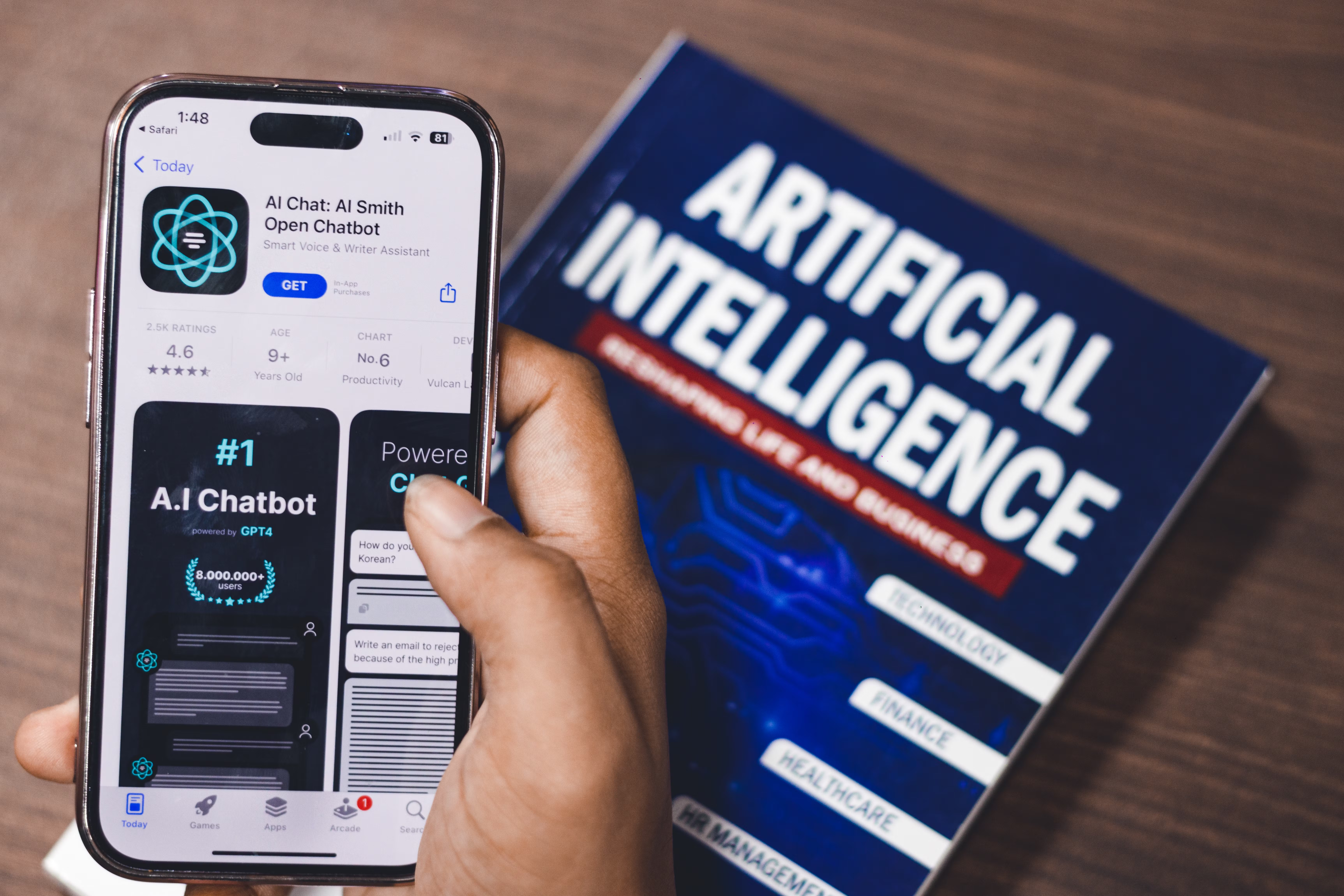
How ChatGPT Search Optimisation Works for Website Owners is a practical question because search is no longer limited to a page of blue links. People now ask AI tools for summaries, comparisons, and recommendations, and those systems may respond with citations, brand mentions, or no visible source at all. For website owners, the challenge is not just ranking in traditional search; it is making content understandable, accessible, and useful enough to be considered in AI-generated answers.
This matters across ChatGPT Search, Google AI Overviews, Google AI Mode, Perplexity, Microsoft Copilot Search, Gemini, and Claude, even though each platform may handle retrieval, source selection, and presentation differently. The best approach is usually not a separate “AI trick”, but a stronger foundation in SEO, content quality, technical access, and clear entity signals.
What ChatGPT Search optimisation actually means
ChatGPT Search optimisation is the process of improving how a website may be discovered, interpreted, and referenced in AI-assisted search experiences. In simple terms, it is about helping an answer engine understand what your page is about, trust it as a useful source, and connect it to the right topic or entity.
That does not mean you can force inclusion. OpenAI does not publish a guaranteed formula for how every source is selected in every search-enabled response. Visibility can depend on query intent, page quality, crawlability, available web content, the platform interface, and how the system chooses to present information at that moment.
For website owners, the key point is that ChatGPT Search is part of a wider shift towards conversational search and generative search. Users may ask longer, more specific questions and expect a direct answer rather than a list of results. That changes how content should be structured and how authority is signalled.
How AI search differs from traditional search
Traditional search engines usually return ranked results that users can scan and compare. AI search tools may summarise, combine, or rephrase information from multiple sources, sometimes adding follow-up prompts or a conversational interface. A user might not click through at all, or they may click only after getting an initial answer.
This creates different visibility outcomes. A page can appear as a clickable citation, be mentioned in text without a link, be used indirectly in a summary, or simply not appear. Those are not the same thing as an organic search ranking, and they should not be measured as if they were identical.
Different platforms also behave differently. Perplexity often foregrounds sources more visibly than some other systems, while Google’s AI features may present answers within the search results page itself. To understand Google’s direction, it helps to review Google’s documentation on AI features in Search, which explains these experiences cautiously and at a high level.
What helps a page become easier for AI systems to use
There is no universal checklist that guarantees visibility, but several signals can improve the chances that a page is understandable and usable for AI search systems. These include helpful content, clear page purpose, strong internal linking, technically accessible pages, and accurate source information.
Entity optimisation is important here. An entity is a clearly defined person, organisation, product, or topic. If your brand is described consistently across your website and other reputable mentions, it becomes easier for systems to connect your content to the right subject. This is not a hidden switch; it is a matter of clarity and consistency.
Structured data can also help by clarifying page meaning. For example, organisation, article, product, or local business schema may make it easier for machines to interpret your content, as long as the markup matches what users actually see. It does not guarantee citation or inclusion, and misleading schema can create quality problems.
Technical access matters too. Search-engine crawlers, AI-related crawlers, training-related crawlers, and user-triggered retrieval are related but not identical. Allowing one does not guarantee use in AI answers, and blocking one does not remove every reference from every system. Before changing robots.txt or server rules, check current documentation and test carefully. A useful starting point for broader site audits is the free website SEO audit from Backlink Works.
AI citations, brand mentions, and referral traffic
Website owners often talk about “being cited” in AI answers, but that can mean several different things. A clickable citation may send traffic, while a text-only brand mention may build awareness without a visit. A recommendation may influence trust, but not all recommendations include a source. A referral visit is measurable in analytics, whereas an organic impression or a traditional ranking is a different metric again.
Because AI-generated answers may combine information from several sources, attribution can be incomplete or inconsistent. A brand may appear in one query and not the next, even on related topics. That is normal in systems whose exact retrieval and presentation rules are not fully public.
For website owners, the practical task is to monitor whether AI search is producing qualified visits, branded discovery, or better awareness of key pages. If you use analytics, look beyond raw traffic and pay attention to landing pages, conversions, assisted journeys, and recurring query themes. Google Search Console and analytics tools can help with conventional search reporting, and these can still be useful alongside AI search monitoring.
Content strategy for generative and answer engines
Generative Engine Optimisation, Answer Engine Optimisation, LLM visibility, and related terms such as GEO, AEO, and LLMO are still developing. Different marketers use these labels in different ways, so it is safer to treat them as useful concepts rather than fixed disciplines with universal rules.
In practice, the best content for AI search is usually also the best content for people. That means accurate information, clear headings, direct answers, strong examples, and enough detail to satisfy the user’s intent. Thin pages, duplicated explanations, and unsupported claims are weak for both traditional SEO and AI search visibility.
AI-generated content can be helpful, but only when it is carefully reviewed. Unedited output can contain factual errors, stale information, generic phrasing, or a tone that does not match your brand. Human editing, source checking, and editorial responsibility remain essential. Traditional SEO is not obsolete; it still supports discovery, indexability, and trust, which can help both human and AI-driven search journeys.
If you are building or refining link authority as part of that foundation, the ultimate guide to backlink building can help you think about authority in a broader SEO context, not as a shortcut to AI visibility.
Common mistakes website owners should avoid
One common mistake is assuming that one platform works like another. ChatGPT Search, Google AI Overviews, Copilot Search, Gemini, Claude, and Perplexity may all retrieve and display sources differently. A tactic that appears useful on one platform may do little on another.
Another mistake is trying to “optimise for AI” by ignoring readers. Content written only to be summarised by machines can become repetitive or unnatural. The better approach is to make pages concise, scannable, and genuinely useful for humans while keeping the underlying facts clear enough for systems to interpret.
A third mistake is focusing only on citations. Visibility in an AI-generated answer is not the same as referral traffic, and referral traffic is not the same as conversions. Track the outcome that matters to your business, whether that is enquiries, product views, newsletter sign-ups, or brand accuracy.
Conclusion
ChatGPT Search optimisation works best as an extension of good SEO, not a replacement for it. If your site is crawlable, indexable, well structured, and genuinely helpful, you improve the chances that AI systems can understand and use it. But no website can be guaranteed a citation, mention, or recommendation in any AI-generated answer.
The most reliable strategy is to strengthen the basics: publish accurate content, describe your brand consistently, use structured data honestly, keep technical access clean, and measure how AI search affects real user journeys. That approach is more durable than chasing platform-specific shortcuts that may change without notice.
Frequently Asked Questions
Can I make my website appear in ChatGPT Search results?
No one can guarantee that. You can improve the odds by publishing useful, well-structured, accessible content, but selection and citation depend on the platform, the query, and how it retrieves information.
Do AI citations always bring traffic to my site?
Not always. Some citations are clickable, some are not, and some users may get the answer they need without visiting the source at all.
Is structured data enough for AI search visibility?
No. Structured data can help clarify meaning, but it should support strong content, technical accessibility, and a trustworthy website rather than replace them.
Should I change my SEO strategy because of AI search?
You should adapt, but not start from scratch. Strong SEO foundations still matter, and AI search is best treated as an additional layer of visibility rather than a separate world.
- Sponsored Ad -





