
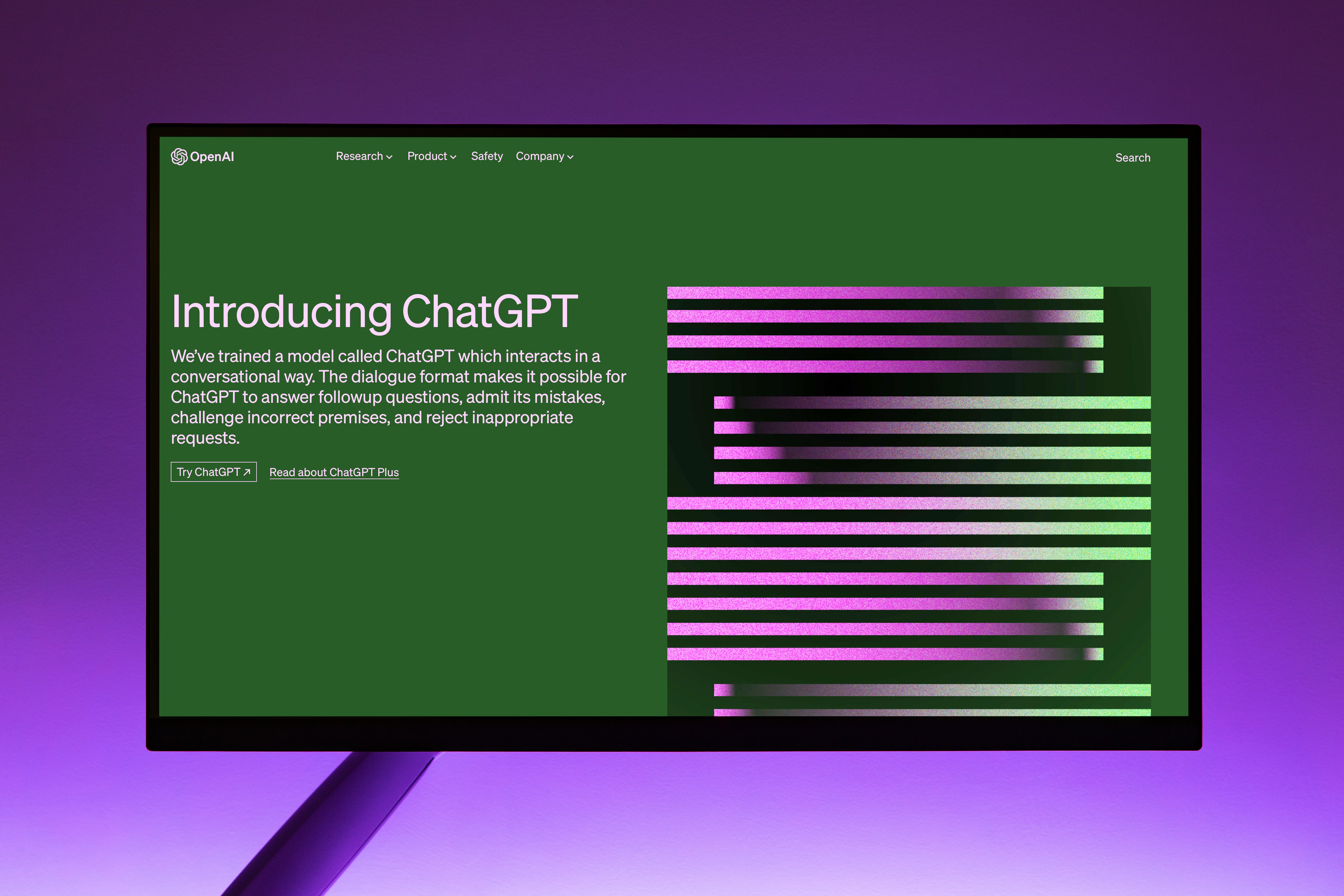
ChatGPT Search for agencies raises a practical question: how do you improve the chances that your content, brand, and pages are understood and surfaced in AI-assisted search experiences without treating them like a traditional blue-link results page? For agencies, this is less about chasing a single ranking position and more about building visibility across generative search, answer engines, and the wider ecosystem that now includes Google AI Overviews, Google AI Mode, Perplexity, Microsoft Copilot Search, Gemini, and Claude.
The key point is that AI search does not behave identically across platforms. Some experiences summarise web sources, some show citations more prominently than others, and some may blend live retrieval with model-generated answers in different ways. That means strong SEO foundations still matter, but they need to be paired with content clarity, entity consistency, structured data, crawlability, and careful measurement.
What ChatGPT Search Means for Agencies
ChatGPT Search can be understood as an AI-assisted search and answer experience rather than a conventional results page. A user may ask a natural-language question, receive a generated response, and sometimes see cited sources or links that support the answer. For agencies, this changes the discovery journey: a page may be used as a source, mentioned by name, or simply left out, depending on the query and the platform’s retrieval and presentation choices.
That distinction matters because visibility in AI search is not the same as a traditional organic ranking. A page can rank well in search yet not be cited in a specific AI response. Likewise, a brand mention in an answer does not automatically mean a visit, a lead, or an endorsement. Agencies should therefore think in terms of AI citations, brand mentions, referral visits, and assisted conversions, rather than a single success metric.
How AI Search Differs From Classic Search Results
Traditional search usually presents a ranked list of pages and leaves the user to choose where to click. Generative search can combine information from multiple sources into one answer, then invite follow-up questions. This conversational search pattern may change which pages get attention and how much context users need before clicking through.
Different platforms also present sources differently. Google AI Overviews and Google AI Mode are part of Google’s evolving search experience, while Perplexity, Copilot Search, ChatGPT Search, Gemini, and Claude may vary in how they cite, summarise, or expose sources. Because the exact selection process is not fully public in every case, it is safer to optimise for usefulness and accessibility than to assume a fixed formula. Google’s own guidance on AI features in Search is a useful reference point for understanding how Google frames these experiences.
Core Optimisation Principles: GEO, AEO, and SEO Working Together
Generative Engine Optimisation (GEO), Answer Engine Optimisation (AEO), LLM visibility, and AI SEO are still developing terms. They are often used to describe practical work that helps content perform better in AI-generated answers: clearer writing, stronger entity signals, better sourcing, and improved technical access. These ideas can complement, not replace, established SEO.
For agencies, the best starting point is usually the same as in traditional SEO: publish content that answers real questions well, structure it clearly, and make sure it is easy to crawl and index. Helpful content, accurate information, and a clean site architecture remain essential. If a page is inaccessible to crawlers or difficult to interpret, its chances of being surfaced in AI-generated answers may be reduced. That said, accessibility alone does not guarantee citation or inclusion.
Practical content checks
Before changing strategy, review whether the page answers a clear search intent, uses plain language, includes source-backed claims, and keeps the main topic visible early in the copy. This is especially relevant for educational content, service pages, product pages, and comparison pages that users may ask AI tools about.
AI Citations, Brand Mentions, and Entity Clarity
Visibility in AI search can take several forms. A clickable citation may send traffic. A text-only brand mention may build awareness without a click. A recommendation may influence choice, even if the user never leaves the AI interface. Traditional search impressions and organic rankings are different again. Treating all of these as the same can lead to misleading conclusions.
Entity optimisation means making your organisation easy to identify as a consistent real-world entity. That includes accurate business names, authors, contact details, about pages, service descriptions, and clear relationships between pages. Structured data can help machines interpret those details, but it does not guarantee inclusion in any AI answer. For Google-specific guidance on clear business information, the official documentation on establishing business details in Search is a sensible place to start.
Agencies should also pay attention to reputation signals. Reputable third-party mentions, reviews, and authoritative references can improve trust, but only when they are genuine. Fake brand mentions, fabricated reviews, or manipulative authority building are poor practice and may backfire.
Technical Access, Structured Data, and AI Crawler Awareness
AI visibility depends partly on technical accessibility. Search-engine crawlers, AI-related crawlers, training-related crawlers, and user-triggered retrieval systems do not all behave the same way. Blocking or allowing one type of crawler does not control every AI system, and each platform may change its approach over time.
That is why agencies should audit robots.txt, meta robots tags, internal linking, canonical tags, page speed, and server responses before making assumptions about AI search. Use structured data where it accurately reflects visible content, not as a shortcut for visibility. Correct schema can clarify page meaning and improve eligibility for certain search features, but it does not ensure AI citations. If you are reviewing markup, validate it against the visible page and current documentation rather than adding generic schema everywhere.
For agencies that need a broader technical baseline, a free website SEO audit can help identify crawlability, indexability, and content issues that may affect both traditional and AI search discovery.
How Agencies Can Measure AI Search Visibility
AI search analytics are still incomplete. Some visits may appear as direct, referral, or unclassified traffic depending on the platform and analytics setup. Referral traffic alone will not reveal every AI-assisted journey, so it is better to combine several signals: landing-page trends, branded search behaviour, enquiries, assisted conversions, recurring prompt themes, and source mentions.
Do not expect every AI citation to produce traffic, and do not assume that traffic means the AI answer was accurate. Instead, monitor whether your brand is described correctly, which pages are being referenced, and whether the topic themes match your core offers. If you publish content for AI visibility, keep an eye on query variations, follow-up questions, and the pages that seem to attract the strongest user interest.
For site owners also working on link equity and wider authority, understanding the backlink building process can help connect AI search visibility with broader organic discoverability, without treating links as a guaranteed shortcut.
Common Mistakes to Avoid
One common mistake is writing only for machines. AI content still needs to serve human readers first. Another is assuming one platform’s behaviour applies to all others. ChatGPT Search, Perplexity, Copilot Search, Gemini, Claude, and Google’s AI features may each use different source-selection and presentation approaches.
Other mistakes include overusing structured data, publishing weak or unreviewed AI-generated copy, and ignoring brand consistency across the site and wider web. Agencies should also avoid promising clients that GEO or AEO will replace SEO. These approaches are best treated as an extension of modern search strategy, not a substitute for it.
Conclusion
ChatGPT Search for agencies is ultimately about improving discoverability in a search environment where answers may be generated, summarised, and cited rather than simply listed. The most practical approach is to strengthen the basics: useful content, clear structure, credible sourcing, technical accessibility, and consistent entity signals.
If you want AI search visibility to support real business outcomes, focus on the parts you can influence responsibly. Publish content that answers questions well, make your site easy to crawl, keep your brand information consistent, and measure visibility in a way that reflects clicks, mentions, and conversions rather than vanity signals alone.
Frequently Asked Questions
Can ChatGPT Search guarantee citations for my website?
No. Visibility in AI-generated answers can vary by query, platform version, source availability, and many other factors that are not fully public.
Is GEO the same as SEO?
No. GEO is usually used to describe optimisation for generative answers, while SEO covers broader search visibility. They overlap, but SEO remains important.
Do structured data and schema guarantee AI mentions?
No. Structured data can help clarify meaning, but it does not guarantee inclusion, citation, or recommendation in AI search systems.
How should agencies measure AI search performance?
Look at a mix of indicators such as referral traffic, branded enquiries, recurring query themes, visible citations, and whether AI answers describe your brand accurately.
- Sponsored Ad -





