
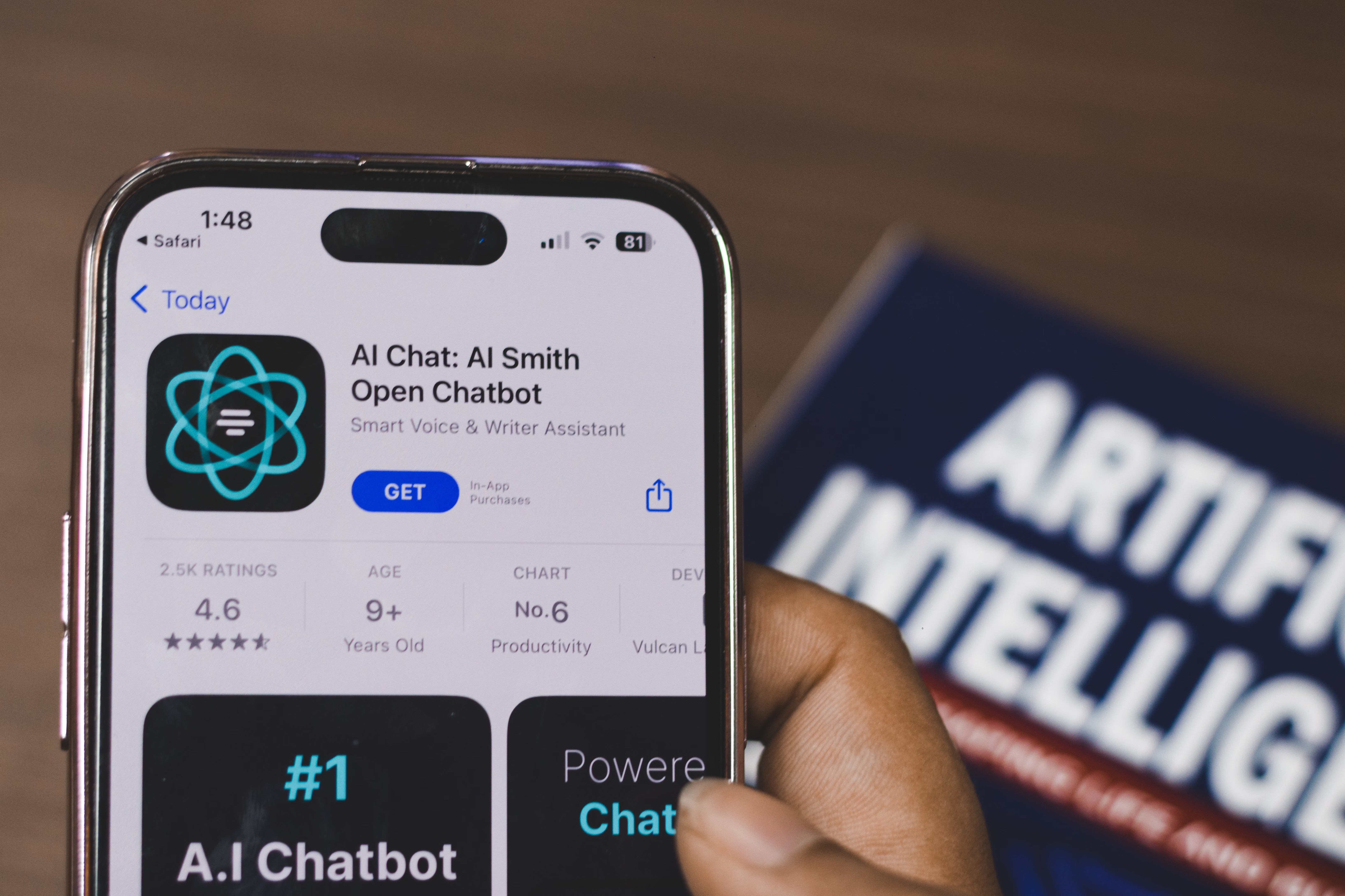
ChatGPT Search vs Perplexity vs Copilot Search is becoming a practical visibility question for brands, publishers and site owners. These tools do not simply list links in the same way as traditional search engines; they often generate answers, summarise sources and encourage follow-up questions, which changes how people discover websites.
For Backlink Works Insights, this matters because AI search visibility now sits alongside conventional SEO, not instead of it. If you want your content to be easier for answer engines and generative search systems to understand, you need to think about crawlability, entity clarity, structured data, brand mentions and the quality of the page itself.
How AI search changes discovery
AI search systems are designed to answer questions in a conversational way. Instead of showing only a page of blue links, they may present a response that combines information from multiple sources, then cite a few of them or offer related follow-up prompts. That means a user can learn from your content without visiting your site, or they may click through after seeing a citation, depending on the platform and the query.
This is one reason “visibility” in AI search needs a broader definition. A page might be mentioned in an AI-generated answer, shown as a cited source, or simply influence the response without a visible link. Those are different outcomes from a traditional organic ranking, where a page appears in a search results list and earns a click directly from that position.
Google’s own guidance on helpful content and search features remains relevant here, especially for sites trying to support both classic search and AI-driven experiences. For example, the helpful content guidance from Google Search reinforces the value of content written for people first, which is still a sound foundation for discoverability.
ChatGPT Search, Perplexity and Copilot Search: what to compare
These platforms are related, but they are not identical. ChatGPT Search is an AI-assisted search and answer experience from OpenAI. Perplexity is built around search-like responses with visible sources. Copilot Search, within Microsoft’s ecosystem, also blends generative answers with web information. Each product can present citations, summaries and links differently, and those interfaces may change over time.
For website owners, the key comparison is not “which one is best?” but “how does each one present sources, and what type of content tends to be easier to understand?” A detailed guide, an accurate product page or a clearly structured article may be easier for one platform to summarise than another, but there is no public, confirmed formula for guaranteed inclusion or citation.
It also helps to separate three ideas: being cited, being mentioned and being clicked. A clickable citation can send traffic. A text-only brand mention may build awareness without a visit. A recommendation may influence trust, but it is not the same as a referral. Keep those distinctions in mind when assessing AI search traffic and brand visibility.
What affects AI citations and brand mentions
AI-generated answers may depend on content quality, relevance, indexing, source authority, technical accessibility, brand recognition, query context and platform design. Because the exact retrieval process is not always public, it is safer to treat visibility as a set of signals rather than a single ranking system.
Useful content usually has a clear topic, accurate definitions, strong headings, up-to-date facts and evidence where appropriate. Entity optimisation also matters: make sure your organisation name, author details, product names and business information are consistent across your site and important profiles. This helps machines and people understand who you are.
Structured data can support that clarity by describing a page in machine-readable form, but it does not guarantee AI citations or rich results. Use it only when it matches the visible page content. Google’s structured data introduction is a useful reference point for understanding what schema can and cannot do.
GEO, AEO and LLM visibility: useful ideas, not fixed rules
Generative Engine Optimisation (GEO), Answer Engine Optimisation (AEO) and LLM visibility are terms marketers use to describe optimisation for generative search and large language models. They can be helpful shorthand, but they are not fully standardised disciplines with fixed ranking factors.
The practical value of these ideas is that they push teams to improve clarity, source quality, technical access and brand consistency. That can complement traditional SEO, which still matters for crawlability, indexing, internal linking, page quality and user experience. AI search optimisation should support your existing SEO strategy, not replace it.
If you are reviewing your content approach, a broader SEO foundation can still help. A service such as a free website SEO audit can be a sensible starting point for checking technical and on-page basics before you adjust content for answer engines.
Technical access, crawlers and structured content
Different systems may rely on different access methods. Traditional search engines use crawlers to discover and index pages. AI-related systems may use web retrieval, search integration, licensed data or other mechanisms depending on the product. Training-related crawlers, user-triggered retrieval and search indexing are not the same thing, and one does not automatically control the others.
That is why website owners should review robots.txt, meta robots tags, page rendering and server responses carefully before making changes. Do not block or allow unfamiliar user agents without understanding their purpose. Check current official documentation first, because crawler names, policies and platform behaviour may change.
Clear page structure also helps. Use headings logically, keep content focused on one main intent, and ensure key information is visible without relying on hidden text or manipulative formatting. If you publish product, local business or profile pages, keep the visible content and structured data aligned.
How to measure AI search visibility without guessing
AI search analytics are still developing, and measurement is often incomplete. Some visits may appear as referral traffic, some as direct traffic and some may be difficult to attribute. That means you should look at more than one signal: landing pages, referral sources, branded queries, enquiries, assisted conversions and recurring search themes.
Do not assume that a brand mention always means traffic, or that a citation always means endorsement. Instead, monitor whether the content being surfaced is accurate, whether the source context is fair and whether the visits that do arrive are qualified. This is especially useful for ecommerce, publishers and service businesses where one good answer may influence a later purchase decision.
- Check whether your key pages are indexed and accessible.
- Review whether brand names and product names are consistent.
- Look for repeated AI-driven query themes in analytics and search data.
- Update pages that are outdated, thin or poorly sourced.
Conclusion
ChatGPT Search, Perplexity and Copilot Search all point towards a search experience that is more conversational, more synthesised and more dependent on source quality than a simple list of results. That does not make classic SEO obsolete. It makes it more important to build useful pages, keep technical foundations strong and present a clear, trustworthy brand across your site and wider web presence.
The most practical approach is measured rather than speculative: improve helpful content, strengthen entity consistency, use structured data accurately, and track how AI-generated answers affect visibility, mentions and referral visits over time. For many sites, that is the best way to prepare for generative search without chasing promises that no platform can guarantee.
Frequently Asked Questions
Can I optimise a page to be cited in ChatGPT Search or Perplexity?
You can improve the chances that your content is understandable and useful, but you cannot guarantee a citation. Platform interfaces, retrieval methods and source selection may vary by query and over time.
Is Copilot Search the same as Google AI Overviews?
No. They are different products from different companies, and they may summarise information in different ways. Google AI Overviews are part of Google Search, while Copilot Search is part of Microsoft’s ecosystem.
Do structured data and FAQs improve AI visibility automatically?
No. Structured data can help machines interpret page meaning, but it does not guarantee inclusion in AI answers. FAQs can be useful when they genuinely help users, but they should not be treated as a shortcut.
Should I change my SEO strategy for AI search?
Refine it, rather than replace it. Focus on clear content, technical accessibility, authority, brand consistency and useful measurement so your site serves both human readers and AI-driven discovery systems.
- Sponsored Ad -





