
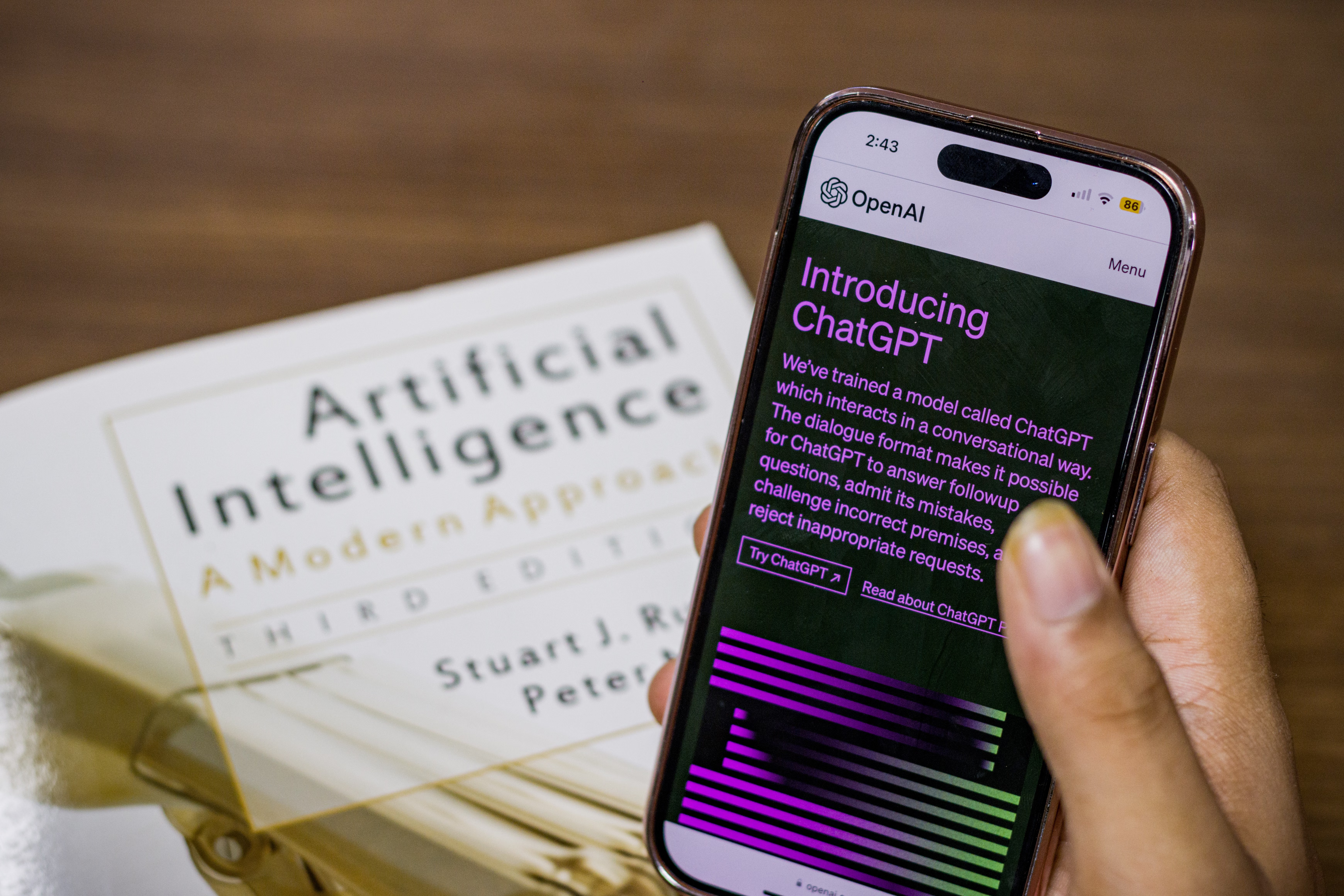
ChatGPT Search and Perplexity Citations are changing how brands think about discoverability, but not in the same way as traditional blue-link search results. Instead of only ranking pages, AI search systems may summarise, cite, mention, or combine information from several sources to answer a question directly. For brands, that means visibility can now depend on how clearly a page explains a topic, how trustworthy the source appears, and whether the content is accessible to the systems that retrieve and summarise it.
This matters because AI-generated answers can influence what users read first, which sources they trust, and whether they click through at all. Brands that understand ChatGPT Search and Perplexity Citations: What Brands Should Know can make better decisions about content, structure, technical SEO, and measurement without assuming that every AI platform works the same way.
What AI search means for brand visibility
AI search is often described as generative search or an answer engine experience. In simple terms, a user asks a question in natural language and the platform produces a response that may be written with the help of multiple sources. Some systems also show citations or source links alongside the answer.
This is different from a traditional search results page, where users choose from a list of pages. In AI search, the platform may interpret the query, retrieve relevant material, and present a shorter synthesis. That can create opportunities for brands to be mentioned in a helpful context, but it can also reduce the number of clicks if the answer fully satisfies the query on the page.
For website owners, the main takeaway is not to chase a single outcome. It is to make content easier for people and machines to understand: clear topics, strong page structure, accurate facts, and trustworthy entity information all help support discoverability across search experiences.
ChatGPT Search and Perplexity citations: what brands should know
ChatGPT Search should be understood as an AI-assisted search and answer experience, not a guaranteed ranking system with published rules. Depending on the query, the product version, and interface changes, it may surface sources, summarise web content, or provide clickable citations. Those citations are not the same as a traditional organic ranking.
Perplexity is also built around answer generation with source attribution. In practice, users may see citations attached to parts of the response, but the selection and presentation of sources can vary by query and product behaviour. A citation may support a claim in the answer, but it does not automatically mean endorsement, referral traffic, or long-term visibility.
It is useful to distinguish between a clickable citation, a text-only brand mention, a recommendation, a referral visit, an organic impression, and a normal search ranking. These are related but not identical. A brand can be mentioned without being clicked, cited without being favoured, or visited without being explicitly cited.
For practical context, OpenAI’s public product pages and help material on ChatGPT search and product discovery are a sensible starting point when reviewing how the experience is described by the platform itself.
How AI systems may select and present sources
Different AI platforms do not function identically. ChatGPT Search, Perplexity, Microsoft Copilot Search, Gemini, and Claude may differ in how they retrieve information, how they present source links, and how much context they show around a citation. Some may lean more heavily on live web retrieval in one query and less in another. Others may show follow-up questions or related answers that change what the user sees next.
Because the exact selection process is not always publicly documented, it is better to think in terms of likely influence rather than fixed ranking factors. Content quality, relevance to the query, crawlability, indexability, authority, brand recognition, user intent, and technical accessibility all appear to matter in some combination, but the weight of each factor is not fully known across platforms.
Structured data can help explain page meaning, but it does not guarantee selection or citation. Likewise, strong backlinks and good SEO foundations may support visibility, but they do not ensure inclusion in AI-generated answers. Traditional SEO still matters because AI systems often rely on content that is already accessible, understandable, and well organised.
GEO, AEO, and LLM visibility without the hype
Generative Engine Optimisation (GEO), Answer Engine Optimisation (AEO), and LLM visibility are terms marketers use to describe making content easier for AI systems to find, interpret, and cite. These labels are still developing, and different people use them differently. They are not fixed disciplines with a universally accepted formula.
Used sensibly, these ideas complement established SEO rather than replacing it. Good page titles, clean headings, helpful summaries, internal links, accurate product or service details, and original expertise can all support both human readers and machine interpretation. For brands that publish guides, product pages, or editorial content, the goal is to answer real questions clearly rather than to sound engineered for a model.
If you want a broader technical baseline, the free website SEO audit from Backlink Works can help identify crawl, content, and technical issues that affect discoverability before you think about AI search-specific adjustments.
Practical steps that improve AI search readiness
Start with content quality. Pages should be accurate, current, specific, and useful enough that a person would trust them even if no AI platform ever cited them. If a page covers a complex topic, add clear definitions, examples, and source-backed claims. Avoid broad statements that cannot be supported.
Next, check entity consistency. Make sure your business name, authors, products, locations, and contact details are consistent across your website and key profiles. Clear organisation information, transparent editorial standards, and credible third-party mentions can all help a platform understand who you are.
Technical accessibility also matters. AI-related crawlers, search-engine crawlers, and user-triggered retrieval are not the same thing. Allowing one path does not guarantee use by another, and blocking one user agent does not remove your brand from every system. Before changing robots.txt or server rules, check current official documentation and test carefully.
Finally, use structured data only where it reflects visible content. Schema can clarify page purpose, but misleading markup creates risk. For implementation details, Google’s guidance on structured data for search is a useful reference point for making pages easier to interpret without assuming any guaranteed AI visibility outcome.
How to measure AI search traffic and citations
Measurement is still imperfect. Some visits from AI search may appear as referral traffic, some as direct traffic, and some may be difficult to separate in analytics. That means brand teams should look at multiple signals rather than expecting a single clean report.
Useful measures include citation presence on key queries, branded mention accuracy, referral visits to priority pages, assisted conversions, and the kinds of prompts that repeatedly surface your content. If a page is cited but not clicked, that may still support awareness. If it drives fewer visits but better-qualified enquiries, that may be more valuable than raw traffic.
As a practical habit, review landing pages that are likely to answer common customer questions, then compare their performance across traditional search and AI-referral pathways where possible. Backlink Works’ backlink building process guide is also useful background reading for brands that want to strengthen authority through legitimate link acquisition rather than artificial signals.
Common mistakes to avoid
One mistake is treating every mention as proof of success. A brand mention is not the same as a recommendation, and a citation is not the same as a conversion. Another mistake is assuming that one platform’s behaviour applies to all of them. Perplexity, ChatGPT Search, Copilot Search, Gemini, and Claude can present information differently.
It is also a mistake to optimise only for machines. AI search content still needs to serve human readers first. Overusing keywords, publishing thin pages, relying on mass-generated content, or adding deceptive schema can undermine trust rather than improve it.
Instead, focus on useful, reviewable, well-structured content that answers customer questions. That approach is more durable than chasing a single interface or trying to reverse-engineer undocumented systems.
Conclusion
ChatGPT Search and Perplexity Citations are part of a broader shift towards conversational search and AI-generated answers. For brands, the opportunity is not to “beat” the system, but to create content that is easy to understand, credible, technically accessible, and worth citing where a platform chooses to cite sources.
Strong SEO foundations still matter. So do clear entity signals, reliable information, sensible structured data, and thoughtful measurement. AI search visibility may grow, shrink, or change form as platforms update their products, so the best long-term approach is to build pages that help users first and remain understandable across changing retrieval systems.
Frequently Asked Questions
What is the difference between a citation and a brand mention in AI search?
A citation is usually a clickable source link or referenced source, while a brand mention may be plain text without a link. They serve different roles and should not be treated as the same outcome.
Can a website guarantee visibility in ChatGPT Search or Perplexity?
No. Content quality, technical access, source authority, query context, and platform design can all influence visibility, but no method can guarantee inclusion or citation.
Do structured data and FAQs make AI citations more likely?
They can help clarify page meaning, but they do not guarantee citations or recommendations. Structured data should match the visible page content and be used accurately.
Should brands change their SEO strategy because of AI search?
They should adapt, not abandon SEO. Traditional SEO, helpful content, brand clarity, and technical health still support discoverability in both search engines and AI-generated answers.
- Sponsored Ad -





